
It isn’t every night that you see an artist perform in a truly comfortable space. Whether it be the innate stress of performance, unfamiliarity with a new venue, or the physical and mental strain tour can take, these (and other factors) can lead to live performances that are, in laymen’s terms, weird.
These issues were absent at The Blockley on Wednesday night, where local artists American Babies and Steve Kimock & Friends came home to roost and blow the proverbial house down. The show lacked the audience-performer dichotomy one finds in larger venues and festivals. The low stage and mingling musicians allowed for an intimate and social setting. The performances were inviting, where those unspoken, potentially awkward barriers between the artist and the people paying to see them were nowhere to be found. No Brechtian audience alienation. This is the jam session in your best friend’s house and everyone came.
Local Americana vocalist and guitarist Tom Hamilton Jr. lead the opening act American Babies, who released their album, “Knives and Teeth,” less than 24 hours before the performance. The musicians seemed to truly enjoy themselves, grooving with ease and comfort. Though the venue was only starting to fill up, Babies did not need the validation of a large audience, playing in a transparent pocket of smooth guitar licks and sweet vocal melodies between Hamilton and keyboard player Adam Flicker.
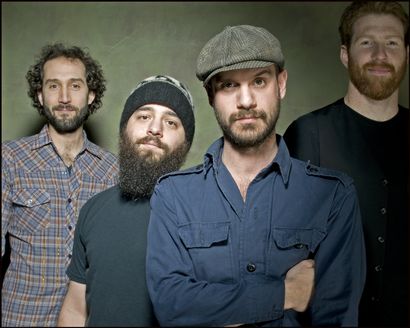
John Morgan Kimock, son of headliner Steve Kimock and drummer for Steve Kimock & Friends, sat in with American Babies, though it was later explained to me they had never jammed before. The musicians played with patience and space, seamlessly dropping into low dynamic ranges and taking their time while down there. Bassist Nick Bockrath provided a focused yet light foundation for the remaining musicians to linger over. Hamilton and Flicker enjoyed bouncing rhythmic motifs back and forth.
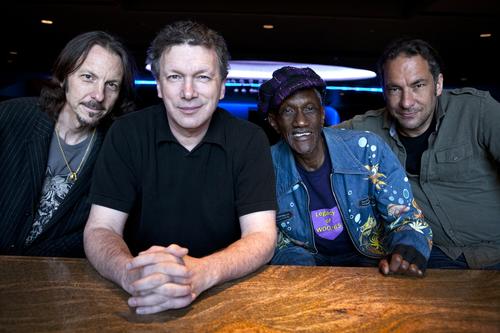
After a short intermission, Steve Kimock & Friends took the stage. Bernie Worrell, keyboard player for Parliament-Funkadelic and Talking Heads and member of the Rock and Roll Hall of Fame, entered with head humbly bowed and long hands hanging freely, all the potential in the world at his fingertips. Though the band has Steve Kimock’s name on it, he is not a front man who demands to be the center of attention. Standing far back on the stage between Worrell and his son, creating a U-shape between the musicians, Kimock allowed the music to happen in the space between.
Steve Kimock was born in Pennsylvania and spent the first 20 years of his life there, moving to the San Francisco Bay Area in his mid 20s to pursue a career with the Goodman Brothers, a folk-rock group. Once settled in the Bay Area, Kimock bounced around playing with various artists, including Martin Fierro and the Underdogs and the Heart of Gold Band, allowing him to expand his vocabulary and experiment within different genres. It is Steve’s versatile outlook on music that gives his playing simultaneous depth and accessibility. He cites artists such as John Coltrane, Miles Davis, The Who, Frank Zappa, and The Beatles as major influences.
In 1984, Steve founded the psych-rock group Zero along with drummer Greg Anton and guitarist John Cipollina (of Quicksilver Messenger Group). The group procured national recognition and gained the membership of vocalist Judge Murphy, whose voice became a signature trademark of the band. Since then, Kimock has toured with multiple members of the Grateful Dead, including drummers Bill Kreutzmann and Mickey Hart, and is known to have had a close relationship with Jerry Garcia.
Steve’s love of music, ranging from progressive rock, to gypsy, to jazz, is prevalent in his playing today. Kimock & Friends shifted between feels at no moment’s notice, led by drummer John Morgan Kimock. John Morgan laid down a fat half time groove that changed effortlessly into a quieter samba feel, with his right hand leading the way on the ride bell with a subtle, groovy ostinato and an uber-light touch on the snare drum. It was difficult not to move your body, and once the band got going, a vivid pulse permeated throughout the crowd.
Though Bernie Worrell’s composure seemed sullen, even standoffish at times, there is no question that he is integral to the pocket. Worrell picked up rhythmic subtleties coming from the percussion and played with them, filling in rhythms left open by John Morgan. Worrell’s ability to layer in and supplement what happened around him contributed to the prog rock essence of the performance. Each individual’s instrument spoke their own voice; all pieces of a puzzle that fit just right. Bassist Andy Hess allowed for further mobility between feels and genres, laying down a dubby line for John Morgan to play with, displaying a faster, more hi-hat driven drum and bass feel.
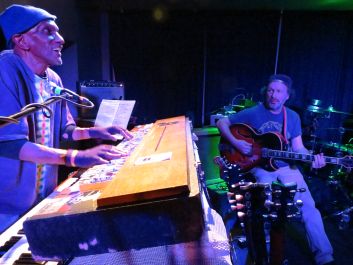
Half way through their first set, Steve Kimock switched from a Fender Stratocaster to a Scott Walker custom guitar, which sang with sweet clarity in the higher register. Worrell switched from a classic organ to his most famous keyboard, the Minimoog synthesizer, made famous in P-Funk songs, “Flash Light” and “Mothership Connection (Star Child).” The Minimoog provided a warm yet atmospheric sound as Worrell shifted up and down octaves and freely embellished using the Moog’s array of filters and modes.
Invented in 1970, there is an interstellar quality about the Minimoog’s sound, soaring with techno highs and sustaining warm low oscillations. Worrell’s keyboard manipulations allowed for the musicians to dabble in the hazy place where genres coexist and perpetuate each other. This is no surprise, especially coming from Worrell, who cites 1970s English prog act Emerson, Lake & Palmer as one of his primary influences. It was especially grounding to hear the musicians shift into an ultra dubby rendition of Bob Marley’s, “Get Up, Stand Up,” reminding us all that there is always room for the classics.
Moving into the end of their first set, Kimock & Friends were joined by another Philly friend, Tom Hamilton, and the groove took on a more ambient, loopy shade, displaying the groups unending versatility. Though the layering was thick and no doubt strewn with complicated composite rhythms, the whole picture never seemed overindulgent or busy.
After a short break, the band retook the stage with front woman Camille Armstrong of Bethlehem, Pa. Donning a djembe, a few pitched temple blocks, and a voice comparable to Esperanza Spalding with a little more rhythm and blues infusion, Camille brought a vibe and presence of her own to the band; the percussive implements lending an Afro-Cuban backdrop. Andy Hess truly showcased his strong vocal abilities during the hot southern jam Red Hot Mama, blaring harmonies that shook the foundation. The group truly jammed beats 1 and 3 into the ground.
Even with cameras in his face and the growing intricacies of the groove, Bernie Worrell stayed in his element, truly a seasoned veteran and master of his craft, nonchalant as his fingers blazed over the keys with dictation. As Steve switched from the custom Walker back to the Strat, Worrell got up and whispered in his ear, laying a hand on his shoulder, both sharing a laugh. There is no doubt that these musicians share a common ground, bread from different cloths but ultimately sharing the same love of all music. The two men represent two very different worlds, yet it is their ability to do away with any subjective comfort zone inside restricting genres and just jam that makes their playing so organic.
Review written by Dan Schack
Like The Music Vibes on Facebook
Follow The Music Vibes on Twitter
©2013 The Music Vibes All Rights
Recent Comments